
Check what the organization accepts
Thrift stores and donation centers take most everyday clothing, shoes and accessories, as long as someone could wear them again. What they turn down differs by organization and region, so check its website or call before a big drop-off. Ask in particular about:
- Clothes with stains, tears or heavy wear. Some places pass these on to textile recycling, others don’t want them at all.
- Underwear, socks and swimwear. Many take them only new and unworn.
- Shoes. Usually welcome when they come in pairs and are still wearable.
- Wet, moldy or smelly items. These are rejected almost everywhere, because they can spoil everything around them.
Prepare clothes for donation
- Wash and fully dry everything. Damp clothes in a closed bag start to smell within days.
- Empty the pockets and remove anything personal.
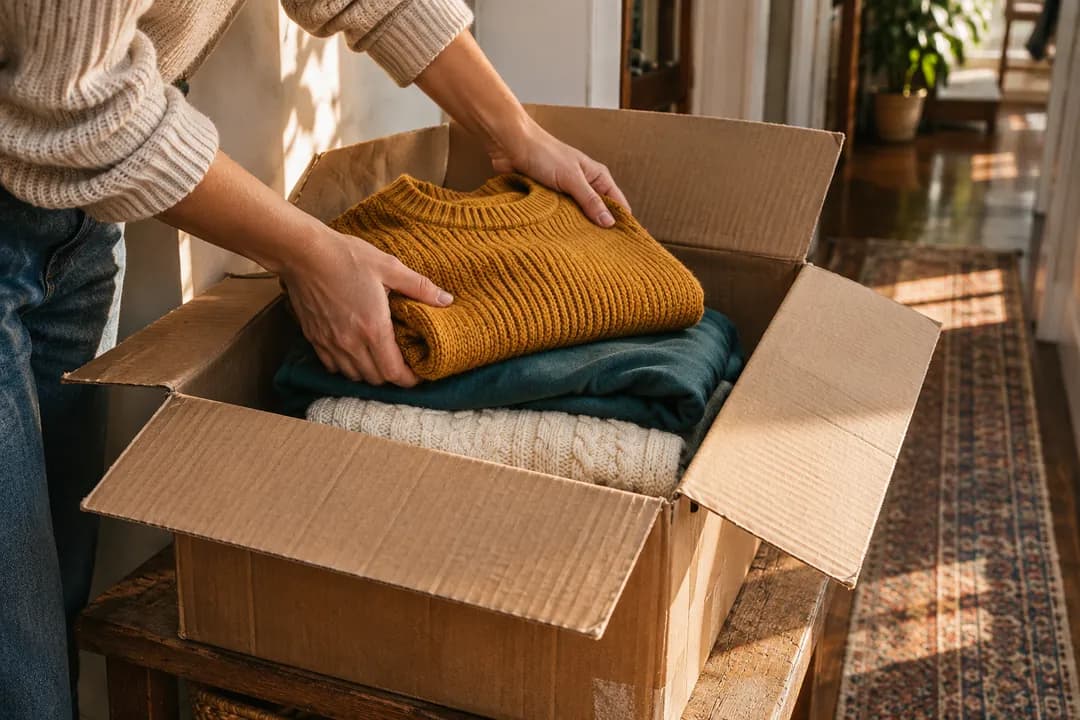
- Fold the clothes and pack them in bags or boxes you can close. Loose clothes get dirty and are hard to carry.
- Tie or rubber-band shoes together in pairs.
- Keep clothing apart from housewares, so the drop-off staff can sort quickly.
Choose a store, donation center or bin
There are three common ways to give clothes away:
An attended door or drive-through at a thrift store. Staff take your bags and can give you a receipt.
A standalone, usually attended site that only collects. Often near a parking lot, sometimes with a drive-through.
An unattended container, open around the clock. Convenient, but no receipt and no one to ask.
Not every donation bin belongs to a charity: some are run by companies that resell textiles. The bin should name who runs it. If it doesn’t, or you want your clothes to support a specific cause, use an attended drop-off of that organization instead.
Large charity and thrift chains take donations at most of their stores, for example Goodwill (3,307 stores on our map), The Salvation Army (1,042 stores on our map), St. Vincent de Paul (396 stores on our map), Savers (180 stores on our map), Arc Thrift Stores (50 stores on our map), Deseret Industries (48 stores on our map).
Confirm donation hours and access
Donation hours are often shorter than store hours: many drop-offs stop accepting an hour or more before the store closes, or only take donations on some days. Check the hours on the organization’s website or call.
- Find the donation door. It is often at the side or back of the store, not the main entrance.
- Ask whether there is a drive-through lane or someone to help unload heavy bags.
- Never leave bags outside a closed store or next to a full bin. They get wet, scattered or thrown away.
Ask the organization about receipts
Attended drop-offs usually hand out a donation receipt if you ask. It typically shows the organization’s name and the date, while you fill in what you gave and its value yourself.
Whether a donation lowers your taxes depends on your own tax situation and on the organization, and some thrift stores are not charities at all. Ask the organization about its status, keep your receipt and a list of what you gave, and check with a tax professional if it matters to you. We can’t give tax advice.
Find clothing donation locations
Switch the map to “Donate” to see places that take donations near you. Each store page says whether donations are confirmed for that location or only typical for its chain, and lists the store’s phone number so you can check the hours.
Giving away furniture? Read how to donate furniture: it works differently.